


Generation Z has grown up on the internet. For us, it's second nature to find whatever information we want at our fingertips, when we want it, or to find information we never wanted or needed. In my teenage years, I practically lived on my phone. For this project, I used web extensions to track the websites I visited and the types of content I consumed over the course of three days. I wanted to get a clearer picture of how I actually spend my time online, since it can be easy to underestimate or overlook certain habits when using the internet throughout the day. By recording the platforms I used and categorizing the content as school, leisure, or personal, I was able to see patterns in my daily media consumption. My goal was not only to measure how much time I spend online, but also to better understand what kind of media consumer I am and how my internet use reflects my priorities, interests, and responsibilities. I wondered if I'd find a durastic change in my time spent digitally now versus how it once was.

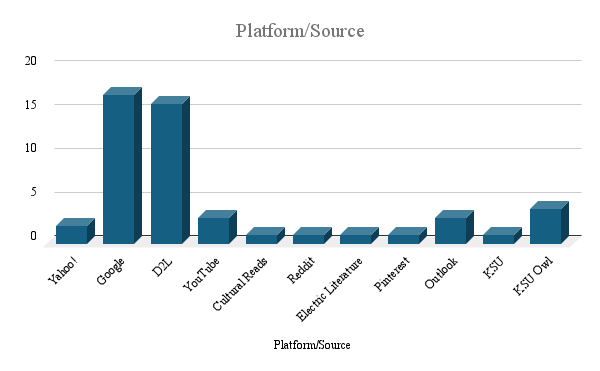

My internet on my computer content intake appears fairly balanced, but it is clearly shaped by my academic work. According to the data, 38% of the content I consume online is school-related, while 32% is leisure content and 30% is personal use. This suggests that the internet functions primarily as a tool for my education whenever I open my laptop. A large portion of my time online is spent researching, completing assignments, or accessing course materials. However, the relatively close percentages between leisure and personal use also show that my internet habits are not entirely focused on productivity. Platforms like YouTube, Reddit, and Pinterest appear in my usage, although not nearly as often as academic platforms. I still spend a significant amount of time exploring personal interests and entertainment, which oftentimes means I'm randomly deep-diving into different topics that pique my interest, and making creative boards on Pinterest like a digital scrapbook.
Google and D2L make up the majority of my platform activity, which makes sense because they are essential for searching for information and accessing class materials. Google often acts as my starting point whenever I need to research a topic, while D2L is where I check assignments, readings, and course announcements.
Interestingly enough, the statistics on my phone are quite different. My phone is mostly no business, all play. I do tend to spend time in my Notes app for organizational purposes, using it to make to-do lists or write down things to remember. I use Safari for my searches and don't tend to use Google, which I find interesting.
There are other utility platforms I'll use as well that make my daily life easier. But their average screentime over the days I tracked my device activity are so low they weren't worth graphing.
So what can be learned about how we tend to use the internet? What do these trends actually prove?
With the trends I was able to track through this project, I felt encouraged seeing my activity on my computer. Increasingly, it is used primarily as a tool. It's the time spent on my phone that has a bit more to say. My screen time as a teenager used to be abhorrent. I give myself grace because a huge part can be contributed to the pandemic, when I was consistently engaged in long text threads and phone calls to pacify my social battery. My screen time is more than half what it was, which is good news. However, I spend more time on social media platforms than I used to. I can infer that my changes in how I spend my time digitally can largely be attributed to my downtime after work and school. I am far more active during the night.
Through research, the upcoming generations are experiencing problems that are uniquely due to growing up with the Internet entirely in their grasps. My linguistics studies infographic that can be found on this page emphasizes the way that the internet and particularly social media has influenced the ways we communicate with one another. There is plenty of good that can be found with a tool meant to connect people from all places... but without being used productively, it can take over our lives rather than enhance it. Through this tracking activity, I've been reminded to reorient the ways I approach my leisure time.

This research was used to make a group presentation, which can be viewed by clicking the link below.