In my time at school, I've contemplated various career paths that centralize two of my loves in life - reading and writing. With the progression of time and opportunity to take an array of classes, I've found my niche. This interview process gave me the chance to talk with two incredible individuals to create an intersectional idea of a field I've grown more and more infactuated with.

This infographic shows that I've had an... interesting path. I came to school thinking I was going to work in Special Education, following the wonderful experiences I had in a club I joined in high school. Yet, I found myself intrigued by linguistics as I decided to broaden my options to focuses more reliant on written communication. Now, I've decided I want my love for the science of language to support me in the study of law, hoping to create a lasting inpact on others in a different way.
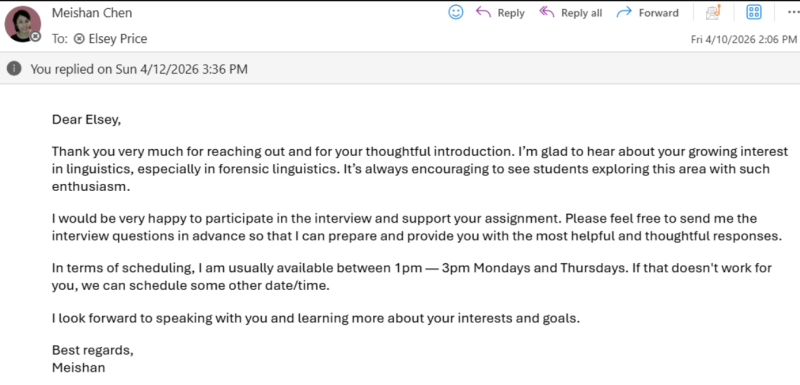
It was an interesting process, finding candidates for this interview. I learned that my first candidate, John Olsson, had sadly passed away a few years ago. Next, a professor at Kennesaw State University, Meishan Chen, fell ill and was unable to conduct a meeting with me. I contacted my cousin, Doug Rogers, hoping his work as a tax lawyer could propel some of my work. Through pure luck, I was able to collaborate with both Professor Chen and my cousin Doug Rogers to gain insight on the study of forensic linguistics, as well as working in a legal field!

What exactly is Forensic Linguistics?
Forensic linguistics is a specialized focus of linguistics, which is the science of language. This field studies and applies knowledge of language to "forensic" focuses, helping in judicial proceedings and legal investigations centered around/denoting unique language usage.
So, this looks like the examination of:
- Contracts
- Authorship
- Ransom notes or threats
A video from John Olsson's YouTube that talks briefly about a couple cases he's assisted in.
John Olsson was a forensic linguist and Professor at Bangor University in Wales.
He is known for assistance in cases across the globe regarding hoax letters and even kidnapping. He has worked with cases in extortion, fraud, frogery, and forms of organized crime.
His job is not one easily obtainable, as you can imagine. However, his work is an example of the focuses in linguistics and law that I'd like to study!


"We use language every single day, yet many people are not fully aware of its power: how it shapes perception, influences relationships, and affects outcomes in contexts ranging from education to law." - Meishan Chen
To talk more about linguistics, I reached out to Meishan Chen, a professor at Kennesaw State University that teaches linguistics, including forensic linguistics. She told me that while her interests in this field developed over time, she'd had some passions from early life that helped her find her way to it. "Growing up, I had a strong interest in detective novels and legal dramas, and I was also deeply curious about learning new languages. At the time, I never imagined that these two interests could intersect in a meaningful way, much less become the foundation of my academic and professional career," she explained. With her excitement to feed her love for forensics, she studied with a professor at the University of Pennsylvania, whose "work on language change sparked [her] curiosity about how linguistic forms connect to social meaning." She pursued a Ph.D. at Northern Arizona University and was mentored by two Professors that sparked her interest in corpus linguistics, the systematic study of language variation across different contexts.
Through schooling, it was pretty clear to Professor Chen where she wanted to go: academia. She taught in a plethora of environments before working at Kennesaw State, symbiotically exploring her own research with the experiences that came along the way.
Professor Chen appreciates her job as a professor for a lot of different reasons, I learned. "Teaching this subject now feels especially meaningful because it allows me to share with students how interdisciplinary connections can emerge in ways one might not anticipate," she told me, "and how personal interests can evolve into a coherent and impactful academic path." While her job is fueled by a passion for what she teaches, she talks fondly about the connections forged with students as she assists their knowledge and analytical skills.
In the grand scheme of things, the value in this area of focus sheds a greater perspective on the world. According to Professor Chen, "being able to study how language functions in real-life contexts, and more importantly, to help raise awareness of its significance, is immensely rewarding. There is a unique satisfaction in [...] contributing, through both teaching and research, to a deeper understanding of one of the most fundamental aspects of human life." She elaborated by informing me that in teaching linguistics, it's always a priority to take in account all demographics of ethical positions, backgrounds, and language evolution while instructing. And, while I don't see myself going into academia, this conversation reminded me why I'd orignally wanted to pursue Special Education, as I admire and appreciate the importance of teaching. Regardless of the field, fostering an environment where eager students can work with you, and together, in enrichments on topics is greatly rewarding and beneficial.
Towards the end of the interview, I asked Professor Chen to talk to me more about what she believes is vital to know for anyone interested in any field of work pertaining to linguistics. Her answer built upon ideas I'd had, but with more thorough analysis. After stating that linguistics requires deep analytical skills that help apply concepts to real-world principles, she responded: "I would emphasize the importance of being open-minded and willing to embrace different perspectives." She elaborated, "language varies across communities, contexts, and cultures, and a successful linguist must approach this diversity with curiosity and respect." There are both explicit and implicit rules of language as ackowledged by linguistics, and implicit rules are the structures or usage of language that are not perscribed rules to follow. These are the facets of language that are more frequently evolving, therefore necessitating an open mind throughout consideration.


"Humans tend to prize profit and celebrity (even in small circles) over truth." -Doug Rogers
Doug Rogers is my cousin who is now retired, but worked as a lawyer in personal injury cases. My interview with Doug was starkly different from Professor Chen's, as he is not someone that found his line of work through passion. Yet, I still found interesting takeaways from his answers to my questions.
After working as a teacher earlier in his career, Doug decided to shift focuses. This shift was brought about through practical means. "With declining enrollment, I realized I would lose that job through a reduction in force," Doug told me. "The job market was similar across the state, so I started law school with the hope that it would be a profitable profession." In most of my questions regarding any personal takeaways or benefits from his work as a lawyer, Doug came up short. That's not to say he didn't learn anything. When I asked the hardest part of his job, Doug responded cheekily: "Putting up with annoying personalities. Legal work attracts a lot of inflated egos."
On a more serious note, Doug did share about the importance of strong communication in his line of work. "Lawyers need to be precise. However, when talking to non-lawyers - clients, jurors or opposition - it's important to speak in simple language." He told me a story that showed a scenario where this offered a challenge with a client. He described talking with a woman that experienced pain in her spine following an auto accident. Doug asked her when her cervical pain had started, and that produced an interesting reaction. "She looked at me in a weird way and I changed the question to neck pain, since she was thinking cervix," he clarified after a pause. All focuses of legal work requires the ability to break down specialized jargon in a way better recieved, so this example illuminated just what that might look like.
Doug also had something to share about the most important character trait in legal fields, which he says is assertion. Whether that's in a court room, or with any person you work closely with, there is no room to feel shy with your intentions and approaches. "As a trial attorney, you need to be able to speak in front of people. Being prepared and able to work extemporaneously because, even when fully prepared, something unexpected will come up," he informed me. Thankfully, this is something I struggle with in a different way - I am often the most outspoken person in a room, whenever the topic at hand is something I'm personally invested in talking about.
Doug did not choose to become a lawyer because of personal interests, nor did he find his work through a love of forensic linguistics like mine. With that being said, I was curious what he'd say when I asked how he'd tell me how to approach my intended pathway, given he knows about working in the legal field. I find I know more about the linguistics and forensic linguistics side of things, versus the process that goes into entering the field, so his very realistic answer proved quite helpful. "Pick an area of the law you're interested in and focus on scientific, social, political things associated with it... the legal linguistics will come with class work," he pointed out. "If you can, intern somewhere. I did that and was a bailiff in a court while going to law school. I learned how NOT to try cases by watching the baby lawyers make errors. My judge only hired law students and was very helpful."
Conclusion & Key Takeaways
Learning more about John Olsson's legacy before approaching these two different interviews has given me a stronger insight of the expectations, roles, and usefulness in studying forensic linguistics to pursue work as a paralegal or lawyer.
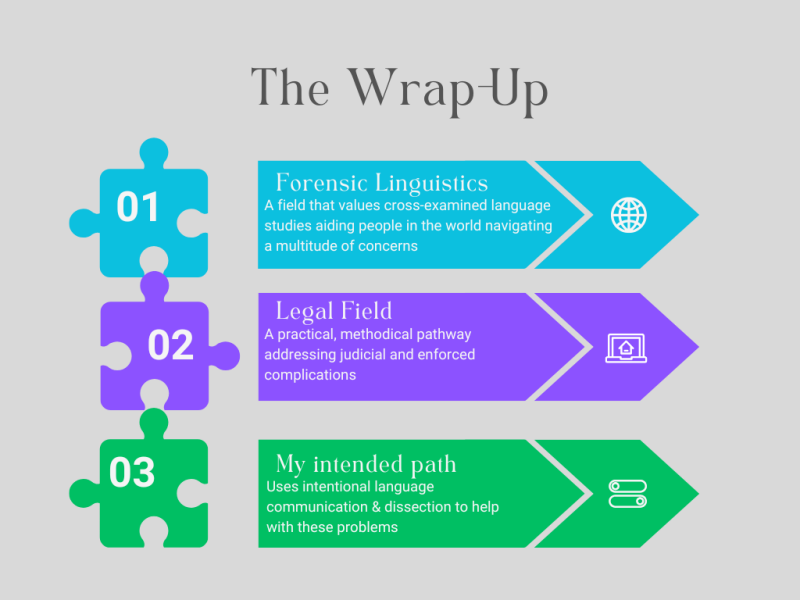
While I don't imagine it will be an easy track, reminding myself why I want to do this work from Meishan Chen, and learning the practical way to approach this job from Doug Rogers, shaped a concrete understanding of what I want, and how to do it.

This interview is also availible to read in the format of a newspaper article.