


In the class I took to build this portfolio, we were encouraged to visit three different opportunities through our school to engage with skills and knowledge that benefit our career development!
Career Resource #1: Government & Non-Profit Fair

This was an in-person fair for students desiring work in non-profit or government organizations. I wanted to attend out of curiosity, as well as some overlapping themes with what I wish to do. I want to use the power of language and voice to implement change on personal and institutional levels. So, I felt it was a valuable opportunity to understand what work looks like in these sectors.
I had the chance to speak with some wonderful students that shared their passion for this kind of work. It was very invigorating to hear how they discussed vital forms of critical analysis and intentional language to carry them in their pursuits. Above all, passion is key when doing this kind of work. Many people prefer to engage with jobs that they care about, but this field specifically is a type of humanitarian cause. And it can be hard work. Many might find themselves feeling underpaid for their efforts and time, and it can take a toll on your psyche. Any work that is fueled by the desire for change, has an undercurrent of discomfort that lead you there. This is something I've had to remind myself of: if I want to change the world, I have to be equipped to handle that change takes time, and change doesn't always look like what we want it to look like.
With that being said, it was clear these students found the right work for their goals. Many had already described community service and organizations they'd been a part of. I came away from this career fair and these conversations with a smile as I pondered the wonderful people that strive for helping others sometimes to their own detriment.
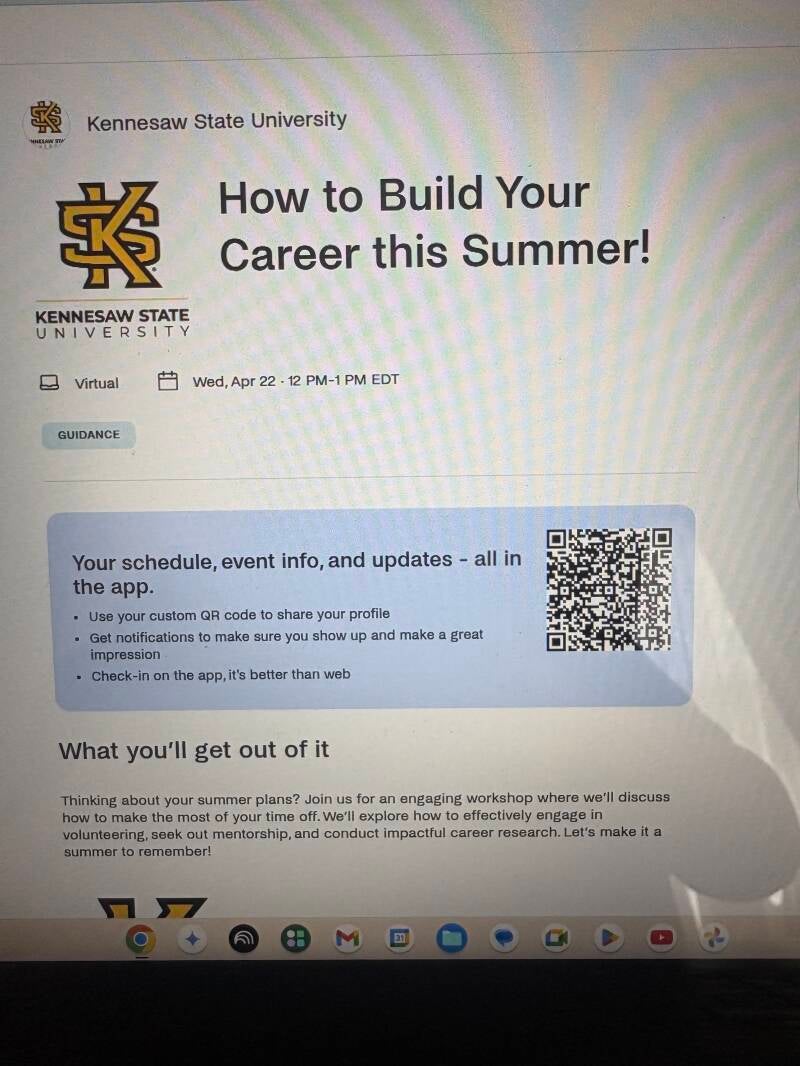
Career Resource #2: How to Build Your Career This Summer
This was a virtual meeting students attended to learn about career strengthening activities or tasks that they could take over the summer.
Personally, as I'm writing this now, I have my own opportunity to build myself professionally with an upcoming study abroad trip to Italy in late May. I'll be staying with other students in an apartment in Tuscany, where I'll take two immersive Italian classes that study its culture, history, and of course, language. I don't currently know much Italian, so I've started taking beginner Italian classes on Duolingo to prepare myself for this opportunity. Since I've taken several Spanish classes in high school and college, I have created a foundational understanding of Romance languages, so this opportunity means a great deal to me. It's an exciting travel experience while inspiring my language and cultural awareness development.
In this virtual meeting, we were advised that any part-time work we could find (if not already employed) is always a great way to develop ourselves for a post-gradute world. It's easy for college students and myself to not value a part-time job besides the money it gives us. As I've learned with serving, any jobs we hold before our career teach us skills that future employers would love to see. I've been able to foster repertoire in customer service, problem-solving, and stress management, just to name a few. The speaker then explained how to use our work to build a compelling resume.
Internships are also a very valuable accomplishment during school to build more realistic transferrable skills for our careers. For many, an internship can look like a job opportunity, if networking efforts are made and a student performs above and beyond expectations. I've personally decided with my pathway that I will forego an intership and focus on working as a paralegal to get hands-on experience with the types of work I plan on doing - but my work as a paralegal will do for me what an internship does for others. It's a way to step into the world and get a taste of the expectations before it's our reality. This session reminded me that intentionality is key, and I will want to be very conscious about where I work and how to use it to my advantage.
Career Resource #3: Regional Marketing Conference & Career Fair

This was another in-person fair for students to learn about marketing and how to market themselves. Obviously, I don't imagine I'm going to go into marketing as a profession. However, I have taken a marketing class before, and there are a lot of things I learned that can be applied in a lot of professions. Marketing is about image and identity, and I am someone that has been learning how to build my own professional identity through this portfolio's development.
The structure of this job fair was a seminar. There was a career panel of a few different speakers explaining the work they did in their jobs, while giving us realistic advice based on the field today. The most relevant part of the seminar was a lengthy discussion about AI. One of the slides during this presentation read, "AI can't replace marketers. But it will take your job." This type of sentiment is something my class has deliberated in great length. Especially during our content writing analyses, we dissected what content writing is: any form of writing on digital platforms that follows a prescribed algorithm for clicks, shares, and the quickest audience engagement. The article we read for class was written before AI has become what it has in writing fields, so we had class discussions about what this could look like now with the addition of AI. As many of us concluded, AI can be a tool. Emphasis on "can-be." There are a lot of environmental and ethical concerns to take in account. As many of us had strong opinions about different elements or effects of AI in our society and particularly writing spheres, we all concluded that it cannot exist within any creative writing contexts as its own entity. AI writing is not liscensable, therefore cannot be correctly published; it cannot be cited as a reference. We have had an informational presentation in this class from a speaker that taught us more about AI, and what it might look like in many of our prospective fields. Ultimately, it comes down to how to use it, given that it has been implemented in many companies.
The speakers in this career fair session rehashed those thoughts. They addressed that while many are fearful that it will replace us at our jobs, that is not something it is equipped to do in a lot of writing fields. Any writing field, for example, that requires human subjectivity cannot be replaced by artificial intelligence. That is a form of critical analysis too complex to be replicated by a computer, as developed as AI has become. But, as time goes on, it will become more competent. More aware. So, if we are not ready to evolve with it, we can be left behind.